
We Were Never Being Boring: A Pet Shop Boys Retrospective (Part One)
Part One: 1988-1991

Welcome to Musings Of A Broken Record, home of Bubbling Under, Beyond The Guess Who, You Should Know About, and That Time…
As usual, be sure to like, comment, share, or hit the subscribe button. Thanks!
This is a three-part series that I originally pitched to Lavender Sound as a standalone article. With permission from Lavender Sound (Max Freedman) I decided to publish the piece here on Musings Of A Broken Record. If you haven’t checked out Lavender Sound yet, I recommend doing so.
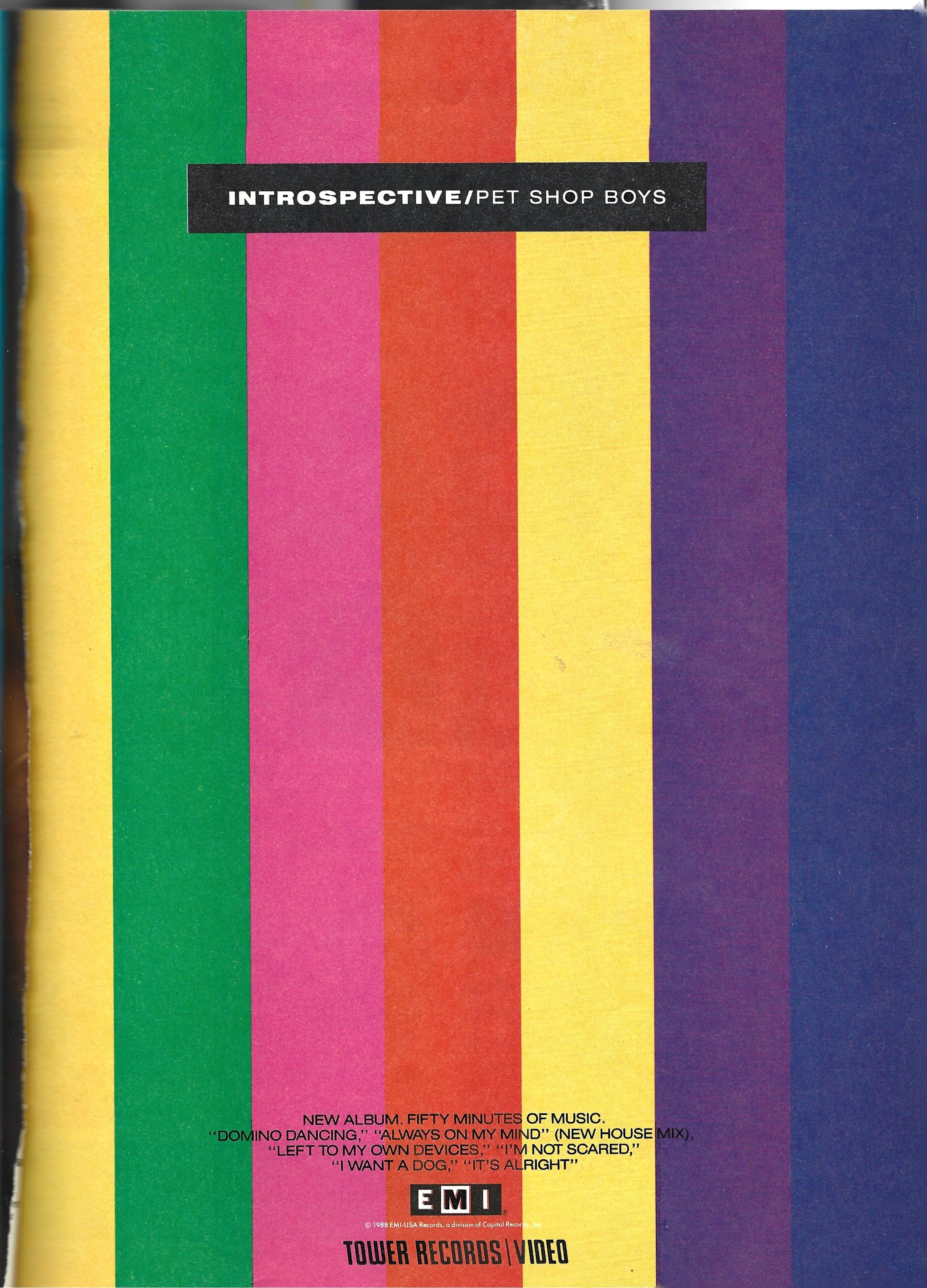
By 1988, Pet Shop Boys were one of the biggest pop acts in the world. They’d managed to crack North America, scored a series of Top Ten Hot 100 hits, including the #1 “West End Girls”. Their third album, Introspective, was expected to be a major success.
The accompanying single, “Domino Dancing”, was influenced by the then-popular freestyle dance music sound. Lewis A. Martinée, one of the most popular producers of the genre, was brought in to produce the track. Martinée had been behind the then-popular girl group Expose, producing their breakthrough hit “Point Of No Return” (1985). It seemed like a perfect recipe for chart success. And initially, it was.
“Domino Dancing” reached the Top 40 before bottoming out at #18, a lower chart position compared to their previous hits (exceeding the 1986 single “Love Comes Quickly,” which peaked at #62). It would be their last Top 40 hit on the Hot 100. A Trevor Horn-produced follow-up, “Left To My Own Devices”, stalled at #84.
It’s a popular opinion that homoerotic imagery in the video for “Domino Dancing” ruined the duo’s hitmaking career in the United States. While there’s likely some truth to this, their sound was too European for a nation being weaned on hair metal and bland pop. In addition to this, Introspective might have actually harmed their career across the pond. The fact that the album only contained six tracks, all lengthy extended versions, is something Tenant admitted years later might have put some fans off the duo.
*************
At the time, Pet Shop Boys, like a number of pop artists, were not out about their sexuality1. The only exception in pop at this point was Jimmy Somerville, one-time frontman of Bronski Beat and The Communards.
Around the time Pet Shop Boys were faltering overseas, The Communards were falling apart with Somerville about to embark on a solo career.
One of the duo’s final UK hits was “There’s More To Love (Than Boy Meets Girl)”. The single contained lyrics such as:
I would like to shout it from the highest mountain
To tell the world I've found love and what it means to me
But all around there's violence and laws to make me think again
Maybe one day they will understand
There's more to love than boy meets girl
It was a far cry from the “Are they or aren’t they?” vibe the majority of pop acts were giving off. Jimmy Somerville was a spokesman, and he felt like other artists, including Pet Shop Boys, should be as well.
Following Introspective, Pet Shop Boys worked on collaborations with other artists, notably Dusty Springfield and Liza Minnelli.
Unlike Tenant, Springfield had discussed her sexuality previously, though somewhat vaguely, in a 1970 interview with the Evening Standard. Her career had been teetering for years before a comeback with her first Pet Shop Boys collaboration, the 1987 duet “What Have I Done To Deserve This?”. Springfield scored further PSB helmed hits in the UK with “Nothing Has Been Proved” (from the film Scandal) and “In Private” (1989).
Liza Minnelli had also been in something of a career rut, though not to the extent Springfield had been. Her last couple of films had been flops, and while she was still (and will always remain) A-List, she was an entertainer in her 40s who wanted to make a contemporary pop record and find a new audience.
Working with both Springfield and Minnelli was an interesting choice. Both had massive gay followings, and the choice of material the duo gave both singers almost seemed to give them an outlet for Tenant to write material drawn from experience without overtly coming out and possibly damaging his career.
In Private contained lyrics such as
“So discreet
I never tried to meet
Your friends or interfere
I took a back seat between”
Minnelli’s big PSB-produced hit was a cover of “Losing My Mind” from the musical Follies. Sure, it was another showtune, but Tenant and Lowe dressed it up to fit their signature sound, scoring Liza a top ten UK hit in the process.
“Losing My Mind” was penned by Stephen Sondheim, another gay man who was likely writing from experience. Lyrically, it’s not much different from PSB’s own material, and to the untrained ear, it’s easy to hear this, mistaking it for one of Tenant and Lowe’s own compositions.
Other gay artists were collaborating with older singers around this time. Jimmy Somerville’s former Bronski Beat bandmates had soldiered on without him. They’d recruited a couple of replacement singers by this point and ditched the activist pop of “Smalltown Boy” for the carefree dance-pop of “Hit That Perfect Beat”. By 1988, they had teamed up with Eartha Kitt for “Cha-Cha Heels”.
Mastermind Steve Bronski and his longtime partner Larry Steinbachek had written the song for the legendary Divine, an openly gay performer who had shot to fame via the films of cult movie director John Waters. Unfortunately, Divine passed away before the song could be recorded, and Kitt, who had scored a comeback a few years previously with “Where Is My Man?” was brought in as a replacement.
Marc Almond, formerly of Soft Cell, teamed up with 1960s star Gene Pitney to record a cover of “Something’s Gotten Hold Of My Heart”. While it was a UK #1 hit, Pitney’s US label refused to release the track, fearing him dueting with another male singer might ruin his career.
***************************
1990 closed with Pet Shop Boys releasing their fourth studio album, Behaviour. The album’s big hit was “So Hard”, a UK #4 hit which teamed the duo up with German producer and one time Giorgio Moroder associate Harold Faltermeyer (of “Axel F” fame).
Earlier in the decade, Faltermeyer had worked with another popular duo, Sparks (brothers Ron and Russell Mael). One of their most overlooked singles was “When I’m With You” (1980) from the equally underrated Terminal Jive album. Before Sparks became repetitive in their later career, they were musical chameleons, successfully genre-hopping from one sound to another.
“When I’m With You” sounded like Pet Shop Boys about six years before the duo started making music. Despite only working with PSB on “So Hard”, Faltermeyer was a great fit for the duo.
“So Hard” also provided an increasingly rare Hot 100 entry for the duo, peaking at #62. It was followed by “Being Boring”, a mini masterpiece that is not only one of the greatest things the duo had recorded at this point, but also one of the best dance-pop singles of the early 1990s.
The lyrics concern getting older, and to the trained ear, there are topical queer issues mentioned. The song was in part about a friend of Tennant’s who had passed away during the AIDS crisis, referenced by the lyrics
“Now I sit with different faces
In rented rooms and foreign places
All the people I was kissing
Some are here, and some are missing
In the 1990s”
The single featured brilliant production inspired by the Stock Aiken Waterman sound. By the time the track was released in November 1990, SAW had fallen out of vogue. Perhaps this was why the single stalled at #20 on the UK pop charts and didn’t have a hope in Hell of crossing the pond. It’s a shame because in a better world, “Being Boring” would have been a huge hit.
Or maybe the duo were just slipping in public favour. It happens to most everyone at some point, and aside from their third single from Behaviour, a medley of U2’s “Where The Streets Have No Name” mixed with Frankie Valli’s “Can’t Take My Eyes Off You”, they didn’t reach the UK top ten again until 1993.
The single would be their last to trouble the Hot 100, peaking at a lowly #72. Although the duo scored further hits in Canada, their career in the US was now confined to the dance charts.
Next Time: Part Two.
While Neil Tennant came out in 1994, Chris Lowe has never publicly come out.
Great piece Mark! As much as I love the early Pet Shop Boys music there is something to be said for the work they did during the period you cover. I was a big fan of some of the songs you mention, such as "Domino Dancing" and "Left to My Own Devices" which now seem like classics to me!
You have a satisfyingly concise way of putting these songs'n'artists into perspective, Mark....where they fit in the music landscape and if and how they were influential! I love that! For all the things people are far too kind and glowing about "my musical knowledge," my well-documented "black hole" is right in this late-'80s/early-'90s time frame you cover here (due to a return to college and radical career change), and it's great to know where these fit into their time in history!
With MAYBE one or two exceptions, I've heard none of these songs (or seen the videos!), while of course, am familiar with all these artists' names. So, your wonderfully pinpoint-writing sure helps me put these "puzzle pieces" into perspective, and a music-factoid nerd like me really appreciates your diligence in laying these out as you do!
I will say I never knew Dusty Springfield (I knew about the duet, but not this song), Liza, Eartha Kitt and Gene Pitney attempted career comebacks in the late-'80s by putting themselves out there to the MTV kiddos in synthy-disco settings!! Pitney didn't look TOO uncomfortable, did he?! And, for him...you're right. I looked it up, and whomever was his U.S. label at the time, there WAS no American release! Still amazing how the label's excuse smacked like a '70s close-mindedness, and not a supposedly more accepting '80s-into-'90s pop culture!
Can't wait for Part 2!